

There Is No Punctum Unless It Is a Photograph
Peter Hoffman on AI-generated imagery and the human touch

A few weeks ago, I shared a piece on photography and truth: Does the camera lie? Hard to say. Around the same time, I read an essay by photographer Peter Hoffman reflecting on the meaning of photography in an era of artificial intelligence. That topic has sparked plenty of conversation here before, so I asked Peter if we could publish his essay on FlakPhoto. Be warned, esoteric ideas ahead! I know many of you will have opinions about this, and we’d love to hear your thoughts. Please let us know what you think in the comments. I hope you like this. Enjoy! —AA
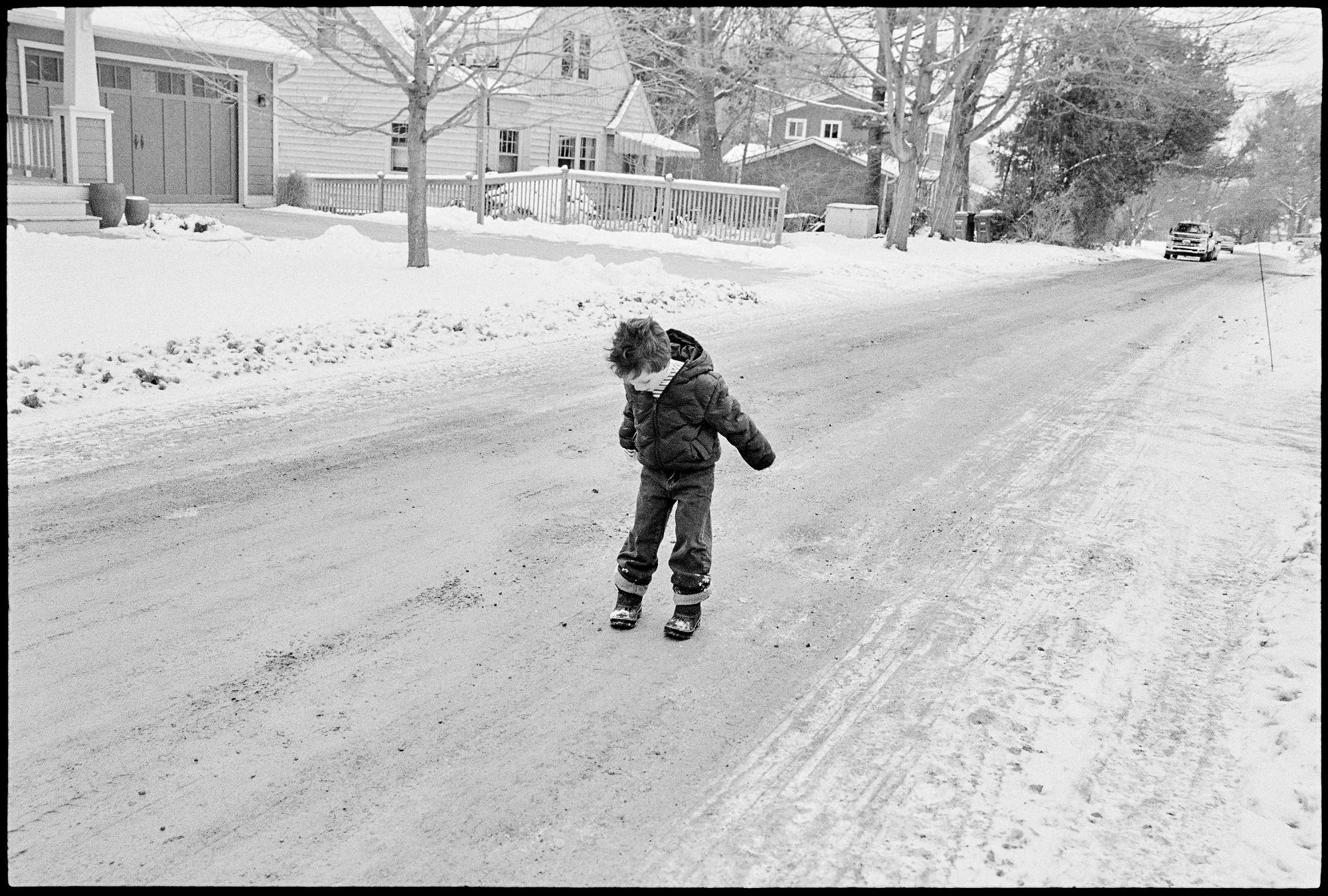
In 1980, French theorist Roland Barthes published Camera Lucida, and since then, very few graduate students in photography have escaped its presence. I was never assigned this book, but it still feels like essential reading — and even essential re-reading. Its only real rivals, in terms of required theoretical texts for the “serious photographer man,” might be Walter Benjamin’s 90-year-old essay, The Work of Art in the Age of Mechanical Reproduction, or Susan Sontag’s 1977 book, an affectionate lashing of the medium called On Photography.
I’ve tended to struggle with critical theory as a photographer. It leaves me both fascinated and dismayed. The problem might be in the name of the discipline. Namely, that when it comes to photography, the theory tends to be overwhelmingly critical. Read enough of it, and it’s hard not to feel as if everything you want to create has been prematurely recognized as problematic. It seems as if every facet of the medium has been attacked and discredited, and that the best thing to do — if a photographer does not want to be complicit in a sort of runaway train of exploitative consumer capitalism (and who does?) — is to disown the pursuit altogether and retreat to an outhouse in the woods. Yes, an outhouse. No, not a cabin.
In the past, after reading Sontag, I’ve wondered whether the most ethical path forward is to put down my cameras, even though I've never wanted to do anything else with my professional life (other than skateboard, but ankles and dreams die hard). This, despite the fact that I do and still believe that photography can be a force for good. After some soul searching, one may realize that theories are only that. In the case of photography, it feels like they often theorize against. But we photographers have a responsibility to try to present better theories for.
And it’s not just me. In 2008, Susie Linfield, in a Boston Review piece titled "Why Do Photography Critics Hate Photography?” explicitly named the problem. A cultural theorist broadly defending the medium still feels uncommon. I expect to revisit her at some point.
This brings me to Roland Barthes.
Camera Lucida stands out for its personal nature. Barthes wrote the book while mourning his mother, as a way to better understand her through the photographs she left behind. The book has a more appreciative, curious, and, at times, bewildered tone towards photography.
To Barthes, a memorable photograph will contain a detail, often small and initially unassuming, and sometimes, to my reading, even incidental, that will break through to the viewer in a particular and wholly subjective way. This detail might be something the photographer does not even notice when making the image, or, if they do, they may not intend for it to be noticed in depth. In the photographer’s mind, it is ancillary.
Barthes calls this detail the punctum, and for me, it is what completes the journey of the photograph, which is to say, from its creation to its recognition by a spectator. The punctum is the sound that must be heard for the tree in the forest to have really fallen. A picture with no punctum is essentially visual noise. It’s never really noticed by a viewer and therefore never really valued. If a picture is never really valued by anyone, its total value is arguably negligible, right? What good is a brilliant book never read by anyone, anywhere?
Barthes’ concept is distinctly personal — it is something beyond and separate from the generally accepted meaning of an image (what he calls the Studium). Besides being personal, Barthes’ punctum seems to be orthogonal to ideas of taste or quality — the traits that seem to be so widely esteemed in criticism. I think this should be notable to any photographer who has had the idea of craft battered into them so hard that it is impossible to see value in a photograph that doesn’t look like a technical achievement.1
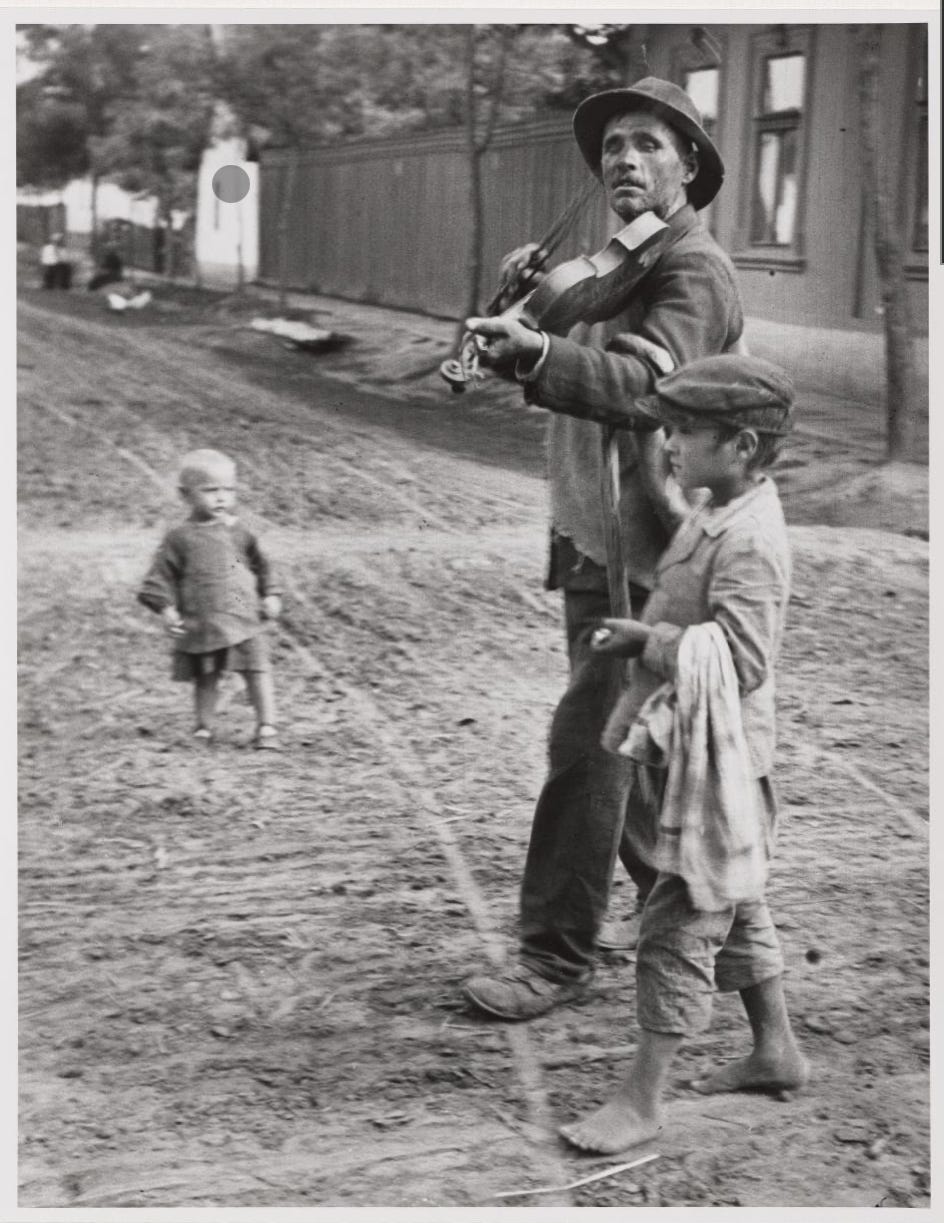
For example, in the image above, Wandering Violinist, Abony, 1921, by André Kertész, Barthes finds his punctum in, of all things, the dirt:
”Now what I see, by means of this ‘thinking eye’ which makes me add something to the photograph, is the dirt road; its texture gives me the certainty of being in Central Europe; I perceive the referent (here, the photograph really transcends itself; is this not the sole proof of its art? To annihilate itself as medium, to be no longer a sign but the thing itself?), I recognize, with my whole body, the straggling villages I passed through on my long-ago travels in Hungary and Romania.”
Why am I bringing up this concept now?
Anyone who knows me understands that, at this point, I tend to look askance at AI technology in most forms. However, I am particularly interested in defending real photography2, especially now when I believe it will be eventually replaced by computer-generated pixel trash heaps of advertising and propaganda, or, in common parlance, slop.
In Barthes, we can find language applicable to today’s situations. I’ve never seen, and can’t imagine ever seeing, an AI-generated image with a punctum. It seems impossible, given how the image is created. That said, an AI-generated image can still have curious, even enticing details — details that evoke emotion or bring up a long-forgotten memory. It’s also possible for an AI image to be interesting (though unlikely) or beautiful (often in the most superficial, least meaningful ways, like the red shell of a Skittle). However, the way AI images are made makes a punctum impossible because they aren’t rooted in anything real. To identify the punctum in a photograph, as Barthes suggests, is a human response to an image with genuine human3 — or at least organic — traits.
In a generated image, no matter how real it appears, the source of intriguing details will always, at its most compelling, be a flaw in the machine process. It’s possible that the punctum could exist in a well-crafted AI-generated image presented as a photograph to a viewer unaware of the image's origin. But does this matter? What happens when they (or I) discover the provenance? The connection to the image through the punctum disappears. At best, the punctum is a fleeting cloud on the ground, a thick fog that leaves one confused and half-seeing, then half-depressed and disappointed for a moment.
The reading of the picture is then obvious: compared to the representation of the physical world, the AI-generated picture leaves me cold. And after that, even a little dead inside, left to wonder what sort of humanistic purpose this image can even serve? No matter what it looks like, it means nothing more than visual static. This impossibility of a punctum isn’t because the image is a lie (many photographs can be said to lie). It’s because the image's origin is non-human. The image's genesis is born of a dehumanizing process.
A flaw in the machine, a curious visual aberration, seven toes on a baby, for example, is about as good as it gets. Any curiosity quickly proves misplaced. The picture loses any novelty and meaning whatsoever as soon as its provenance is known. No matter how it looks, it will always be, should always be, read the same way. It has no connection to anything out in the world. It had no real human intention behind it, and no, I don’t think prompts guiding a machine on what to spit out can count as such. The AI image that looks like a photograph is inherently deceitful; it has nothing good to say to me, to us.
I will close with Barthes again, who draws a direct line between the photographed subject and the resulting image. It’s worth noting that he is referring specifically to black-and-white film and silver prints, and I do think that, with digital technology, the connection he notes is somewhat eroded. Still, I feel the point stands when comparing a photograph to another visual image:
“The photograph is literally an emanation of the referent. From a real body, which was there, proceed radiations which ultimately touch me, who am here.”

About the author
Peter Hoffman is a freelance photographer in Ann Arbor, Michigan.
A note to my younger self, and anyone else who has been through the wringer of photojournalism school, which is a distinctly separate experience from an arts education.
Does this need defining? Is that even possible? Maybe that’s for another time.
A picture doesn’t need to be a portrait or even incorporate people at all to contain the punctum. It does need something ineffable, though, something that I don’t think a machine — and only real life — could ever produce.
This piece resonates deeply with my own perspective, I believe the fundamental line between authentic photography and AI imagery lies exactly where Roland Barthes placed it: in the 'that-has-been' (ça-a-été). A photograph is, first and foremost, a fossilized trace of a presence, the physical certainty that real photons once touched a subject before eventually reaching us. When this bond is severed, as it is with AI, the "magic" vanishes. The punctum cannot be manufactured or sought out as a mere compositional exercise; it must strike you on its own. There is an even more intimate layer to this: we often talk about the punctum as if it were a detail sitting on the surface of the paper, but I’ve come to realize that the punctum is actually within us. It is not an object or a detail, but the emotion that erupts when the external world aligns perfectly with our own 'invisible baggage' (to recall Ansel Adams, the books read, music heard, and people loved that we carry with us). The punctum is the smell of a place or the specific silence of an afternoon from our past that are recalled by the photograph. A photograph is an "open work" that requires our own life experience to be completed. AI can mimic the surface, and it can certainly produce aesthetic perfection, but it can never generate that friction between the real and our inner invisible baggage. Without it the image leaves us cold because it is a silence that has nothing to say to our present.
Punctum. I had to look that up. I've so often wondered if there was a word for the thing in an image that makes us stop scrolling. Sometimes it's hands drawn up in the coat. Sometimes is a barely noticeable but still very noticeable immodest show of skin. In the latter, the punctum is so often overplayed.